
Free webinar · 11 min · Ice cream shop business
Great ice cream isn’t enough: 5 mistakes that cost an ice cream shop money
You can make the best ice cream in town and still lose money every month. In 11 minutes we show you why it happens and how to fix it with a method.
Watch the free webinar (11 min)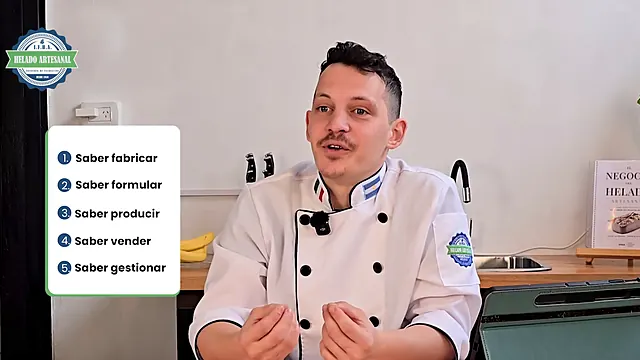 11 min
The full webinarUnlocks as soon as you fill in the form
Free, instant access
Watch the full webinar now
Leave your contact details and we’ll suggest the right next step for your stage.
Where are you today?
Pick one and watch the webinar (11 min).
Your stage: ·
We’ll email you the webinar link and a few follow-up emails with practical tips and our English courses. Unsubscribe in one click. Privacy policy
Done: the video is open. Start with the book, the fastest and most affordable way to get the whole method. Then tell us your stage in “Choose your path” and we’ll point you to the right program.
See the book →My path →Webinar transcriptfull text, edited for reading · 11 min
The recipe is the least of it
Can you give me the recipe? That’s the question we hear most, after years of training ice cream makers and advising shops. We get it from people dreaming of opening their own shop, and from owners with 20 years behind the counter who feel the business slipping away. And the answer is always the same. The recipe is the least of it. Not because it doesn’t matter. It does, a lot.
But because the recipe is the result of something that comes first. Behind every great ice cream, there’s a way of thinking about the product. And behind every great shop, a way of thinking about the business. Look, you can make the best ice cream in town and still lose money every single month. And the opposite happens too. Packed shops, registers ringing all day, and an owner who, at the end of the year, has no idea where the money went.
Over the next few minutes, we’ll look at five mistakes that cost money. Some of them will sting a little, fair warning. And I’ll show you that each one has a method and a solution. Then I’ll tell you how we work at IFHA – Artisan Ice Cream Training Institute. Stick around, because even if you don’t have a shop yet, what’s coming could save you months of guesswork and a lot of money.
Two shops, five skills
Picture two ice cream shops in the same town, 10 blocks apart. Both have a spotless display case. Both have 20-something flavors. Both have a sign that says artisan ice cream. Both post photos that make you want to go. From the sidewalk, they look exactly the same. Now let’s step into the kitchen. In the first one, the owner buys a ready-made base, adds flavoring and cream, and into the case it goes.
If the supplier changes the base tomorrow, the ice cream changes, and he has no idea why. In the second one, there are house recipes, written down, and ingredients chosen one by one. A process that’s under control. When a batch comes out wrong, we know where to look. From the outside, they’re almost identical. Inside, they’re not building the same product. And sooner or later, and we’re talking months, not years, they won’t be building the same business either.
One depends on what it’s sold. The other owns what it sells. This is the heart of it. In this trade, there are five different skills. And almost everyone mistakes the first one for all five. The first is knowing how to make it. That’s following a recipe and getting ice cream. The second is knowing how to formulate: understanding why the recipe works, and adapting it when something changes. The third is knowing how to produce, which isn’t the same as making it.
It means it comes out the same every day, not just when we’re inspired. Then there’s knowing how to sell. That means customers choose you, come back, and recommend you. And then there’s knowing how to manage. Most people who get into this business master the first one, and learn the other four the hard way. Today, we’re going to take a look at the four that almost nobody checks before starting.
Mistake 01 · A recipe isn’t a formula
Two ice cream shops start out with the same dulce de leche recipe. Six months later, the same thing happens to both: their cream supplier runs out. They have to buy whatever they can find. The first one buys it without checking the fat content. Cream is cream, right? The ice cream comes out different. The next week he makes another batch with another cream. Different again. His customers don’t know what changed, but they know something worse.
It’s not the same ice cream anymore. The second one measures the fat in the new cream, grabs a calculator, and in minutes adjusts the rest of the mix. His ice cream comes out the same as always, no matter what happens with the suppliers. The difference between them isn’t talent, it isn’t experience, it isn’t years behind the counter. It’s that the first one has a recipe. A list of amounts you just follow.
The second one has a formula: a structure you understand, adapt, and correct. A recipe tells you how much. A formula explains why. That’s what formulating is: controlling what happens to the mix between the machine and the customer’s mouth. Because your customer won’t always taste your best batch. They’ll taste the one you made today. How do you do it? With what numbers? With what methods? That’s exactly what you learn in the formulation and balancing unit of IFHA’s Master Ice Cream Maker Program.
For today, take this question with you. If an ingredient changes tomorrow, is your ice cream still the same?
Mistake 02 · Copying the competition’s prices
One ordinary Monday, the supplier sends a new price list, and we find out cream just went up. In one shop, the owner looks at the list, grumbles for a while, and is left with three questions he can’t answer. How much does that increase affect the cost of each kilo? Do I need to raise my price? By how much? Or can my margin take the hit? Since he doesn’t know, he does what he always does.
He waits to see what the competition does. And meanwhile, the competition is probably waiting to see what he does. In another shop, same list, same increase. The owner opens a spreadsheet, changes a few numbers, and in minutes knows how much his cost went up, how much margin he has left, and what to do with his price. One reacts blindly. The other reacts with certainty. That’s the whole difference.
Mistake 03 · Eyeballing your costs
Now the real question. What does it cost to make a kilo of ice cream? And here comes the most expensive mistake in the whole industry: answering just by looking at the ingredient list. The real cost of a kilo has five components. Raw ingredients, yes. That’s the only one almost everyone calculates. But also packaging. Energy, what it costs to make the cold that makes the ice cream. Labor: if you’re the one producing, your time is worth money too, even if it doesn’t come out of the register.
And finally, overhead, the share of rent and taxes every kilo carries on its back. In the example we use to teach the method, everything that isn’t raw ingredients is almost half the cost. Exactly the half that gets ignored when you eyeball it. If the price doesn’t cover all five components, every sale leaves a small loss. And the business covers that small loss with the owner’s own money, month after month, almost without anyone noticing.
We call this the silent leak. How to build the spreadsheet that catches it, component by component, is at the heart of the management unit in the Master Ice Cream Maker Program.
Mistake 04 · Revenue isn’t profit
We’ve seen this shop many times. The owner gets up at six in the morning, takes in the milk, pasteurizes, makes the ice cream, fills the case, solves a problem or two, serves customers from noon, closes at midnight. His ice cream is great. It sells really well. In December, with the shop packed, his accountant brings him the numbers, and we’ve heard what comes next over and over. That can’t be right, we sold a ton.
Where did the money go? Nobody stole anything. What happened is a little more uncomfortable. Prices stayed outdated for three months, waste was never measured, two flavors had been selling at a loss since March. Each leak was small, but together, over 12 months, they ate a whole year of profit. Revenue is all the money that comes in over the counter. Profit is what’s left once we subtract all the costs.
Revenue is visible. Profit is quiet. It only shows up if someone calculates it. There’s one number that answers the most important question in the business. How many kilos do I need to sell a day to not lose money? That’s called the break-even point. Below that number, the day ends in the red. Above it, the logic flips and things get good. Fixed costs are already paid, and every extra kilo keeps its whole profit.
That’s why the last kilos of the month are the most profitable of all. And that’s why fighting for sales on a slow winter Tuesday matters way more than it seems. Do you know your break-even point? Does the person who closes your register know it? In the Master Ice Cream Maker Program, this has its own full unit. Costs, pricing, break-even, and a dashboard to keep an eye on everything.
And here’s a line, it’s on the house. What doesn’t get measured, melts.
Mistake 05 · Every tub draws a salary
So far, the invisible numbers. Now let’s look at something you see every day that’s also hiding money. Your display case. Every shop that’s been around a while has an untouchable flavor. Sometimes the founder created it. Sometimes a customer who doesn’t even come anymore asked for it. When we ask why it’s still on sale, the answer usually isn’t about sales. It’s about history. Here’s a case we see all the time in class.
A mid-sized shop, a menu of 48 flavors, and an owner convinced every flavor sells. So we build a sales ranking for the last three months. Usually, we find the top 12 flavors make up half of total sales. The bottom 15 flavors, all together, didn’t even reach half of what dulce de leche sells on its own. All those flavors piled up most of that shop’s waste. So it turned out it was really a 30-flavor shop paying the costs of 48.
Careful, you don’t always have to drop the classic flavor. A lot of times, it’s part of the shop’s identity. The problem isn’t that it’s there. The problem is not knowing what it costs to keep it there. There’s a tool for this. It’s a matrix that ranks every flavor by how much it sells and what it brings in. In IFHA’s Master Ice Cream Maker Program, you’ll learn to build it with your own data.
And here’s a benchmark I’ll give you up front. A modern, well-run shop has around 24 flavors. The winner isn’t the one with the most flavors. It’s the one with the flavors customers want to buy.
The IFHA method
Let’s pause and look at what we just covered. Ice cream that changes when the cream changes. A price copied from the competition. A record year with no profit, and a display case that loses money. Problems that look different, but they’re all the same one. Customers don’t buy ice cream. They buy an experience, held up by a product, funded by an operation. If one of those three layers fails, the other two end up paying for it.
We come from a family that’s been in artisan ice cream for over 75 years. Three generations, a school that’s trained ice cream makers from more than 50 countries. And from that whole journey, the counter, the kitchen, the consulting, the classroom, we distilled one belief that’s the backbone of IFHA and the Master Ice Cream Maker Program. We teach you to make great ice cream, and to turn that great ice cream into a great business.
In that order. Because without great ice cream, no marketing can save you. And without a business, no ice cream survives. The Master Ice Cream Maker Program covers that whole system, in the order it’s built. It starts with the product: what artisan ice cream really is. The raw ingredients, what each one does in the mix, and balancing. The method to go from copying recipes to signing your own formulas.
Then comes production: mixes, cold, equipment, hygiene, and the legal side. We want what you designed to come out the same every day. And it ends where we took a peek today: the numbers and the market. Costs, pricing, break-even, and budgeting. Marketing and your value proposition: why customers choose you, come back, and recommend you. It’s 14 units, where each unit talks to the others. You don’t need prior experience, a shop, or equipment.
The program starts with the very definition of ice cream and takes you step by step all the way to the point of sale.
A real story: Fernando, Program graduate
Franco Alfonsin: “How long ago did you open your ice cream shop, Fernando?”
Fernando Bankowski, Program graduate (Felichità Helados & Co., Oberá, Argentina; in Spanish with English subtitles): “It’s been a month and 23 days. When I started this, all I knew was how to scoop ice cream or serve a quarter kilo, a half kilo or a full kilo of ice cream. I never imagined that today we’d be making an ice cream that’s taking the city by storm.”
“To someone who maybe has the intention or the idea of taking the course: once they finish the program, when they pick up a machine, or pick up a mixer to make ice cream, they’ll realize those were the best five months they’ve ever invested.”
Where to start
Remember the question from the beginning? Can you give me the recipe? Now you know why the recipe is the least of it. So here’s the invitation. If you’re thinking about opening an ice cream shop, if you already have one and feel like you’re working hard, but the results aren’t showing up, or if you want to turn your technical know-how into a real business, join IFHA’s Master Ice Cream Maker Program.
Get in touch to see the full program and the dates for the next cohort. Thanks for staying with us this far. See you at IFHA.
In a nutshell
An ice cream shop rarely loses money because of its ice cream. It loses money because of what it doesn’t measure: the formula, the real cost per kilo, its own price instead of the competition’s, profit instead of revenue, and how well each flavor sells. All five have a method and a fix.
- A recipe tells you how much; a formula explains why. If the cream changes, your ice cream shouldn’t.
- Copying the competition’s price is reacting blindly: a cost spreadsheet tells you what to do in minutes.
- The cost of a kilo has five components; raw ingredients can be barely half of it.
- Revenue isn’t profit: know your break-even point in kilos per day.
- A modern, well-run shop has around 24 flavors. Every tub draws a salary.
What you’ll see
- 0:00“Can you give me the recipe?” The question we hear most, and why the recipe is the least of it.
- 1:01Two shops, five skills Identical from the sidewalk, different inside: making, formulating, producing, selling and managing.
- 2:2301 · A recipe isn’t a formula Two makers, the same dulce de leche recipe and a cream that changes.
- 3:3302 · Copying the competition’s prices Cream goes up: three questions with no answer, and a spreadsheet that answers them in minutes.
- 4:1503 · Eyeballing your costs The five components of a kilo and the silent leak.
- 5:1404 · Revenue isn’t profit “Where did the money go?”, the small leaks and the break-even point in kilos per day.
- 6:4005 · Every tub draws a salary The 48-flavor case: 30 flavors that sell, paying the costs of 48.
- 7:56The IFHA method The shop as a system, and what the Master Ice Cream Maker Program covers.
- 9:30A real story Fernando Bankowski, Program graduate, and his ice cream shop in Oberá, Argentina.
- 10:16Where to start The invitation and the paths for each stage.
The five mistakes
Five problems that look different and are really the same: looking at only one piece of the system
A recipe isn’t a formula
If an ingredient changes tomorrow, is your ice cream still the same?
“A recipe tells you how much. A formula explains why.”
Copying the competition’s prices
Cream goes up and nobody knows how it hits the cost of a kilo, so everyone waits to see what the others do.
“One reacts blindly. The other reacts with certainty.”
Eyeballing your costs
Raw ingredients, packaging, energy, labor and overhead. Everything that isn’t ingredients can be almost half the cost.
“We call this the silent leak.”
Revenue isn’t profit
Revenue is visible. Profit is quiet, and it only shows up if someone calculates it.
“What doesn’t get measured, melts.”
Every tub draws a salary
A modern, well-run shop has around 24 flavors. The winner is the one with the flavors customers want to buy.
“The problem isn’t that it’s there. It’s not knowing what it costs to keep it there.”
Our core idea
We teach you to make great ice cream, and to turn that great ice cream into a great business.
In that order. Because without great ice cream, no marketing can save you. And without a business, no ice cream survives.
What’s next
Start with the book, then choose your program
Everything you saw has a method, a tool and a fix. The book in English is the fastest and most affordable way to start; then pick the program that fits your stage. New in English: the Flex Intensive Course and the Master Ice Cream Maker Program – Flex, both self-paced, with an early-access price.
Start fast, on a small budget
The book: The Artisanal Ice Cream Business
The complete IFHA method in English, from the master ice cream maker’s technique to the decisions that make a shop profitable.
- Fifteen professional formulas
- Costs, pricing and break-even explained
- Read it this week
Kindle · full-color paperback · hardcover
See the bookLearn at your own pace, in English
Flex Intensive Course
Formulation, production and selling in recorded classes you watch from any country, with a 1-on-1 live session with an instructor.
- QR-verifiable certificate
- The institute’s balancing spreadsheet
- No prior experience needed
Pre-enrollment open · USD 719 early access · 10 recorded modules
See the Flex Intensive CourseMaster the whole system
Master Ice Cream Maker Program – Flex
From product to production, and from there to the numbers and the market: the full Program, recorded in English, at your own pace.
- Recipe balancing (POD and PAC)
- Costs, pricing and break-even point
- Product mix and opening your ice cream shop
Pre-enrollment open · USD 1,570 early access · 14 recorded units
Explore the ProgramGet one-on-one guidance, to open or to grow
One-on-one consulting
We work one-on-one on your project or your real numbers, with the IFHA team.
- Opening plan or a diagnosis of your shop
- Real cost per kilo, pricing and flavor matrix
- Off-season cash plan and yearly budget
Tailored · to open or to consolidate
See ice cream shop consultingPre-enrollment is open. Pre-enrolled students get first access as soon as the English edition opens, and keep the early-access price. Full refund on request at any time before your access opens.
Not sure which one fits? Message us on WhatsApp, tell us where you are and we’ll tell you which option fits your moment best.

Who presents
IFHA – Artisan Ice Cream Training Institute
Three generations of ice cream makers since 1950, and a school that has trained 3,500+ students from 50+ countries. The method we teach comes from the counter, the kitchen, consulting and the classroom, in Buenos Aires, Argentina.
What our graduates say
“I’m a chef and I’m about to open my own ice cream shop in Australia. Thanks to IFHA’s course, I gained all the technical and practical knowledge I needed to carry out my project.”
“A top-level ice cream school, with a very practical and professional approach. I learned a lot, not only about recipes and techniques, but also about running an ice cream business with quality.”
“At IFHA you learn real ice cream making, with hands-on classes and no fluff. Ideal if you want to start your business or take it to the next level.”
Frequently asked questions
Why does an ice cream shop with great ice cream lose money?
How much does it cost to make a kilo of artisan ice cream?
How many flavors should an ice cream shop have?
What is the difference between a recipe and a formula?
Is the webinar really free?
Is the webinar in English?
What is the fastest and most affordable way to start?
Do I need experience or a shop to train with IFHA?
Can I take an IFHA program in English?

Start your ice cream project today, with IFHA by your side
All five mistakes can be fixed with a method. Start with the book this week, then choose the program for your stage, or message us on WhatsApp: tell us where you are and we’ll reply with something concrete.
IFHA Labs · Av. Libertador 405, San Fernando, Buenos Aires, Argentina · info@ifha.com.ar